General Outline of Tibetan Buddhism (2)
(1) The Tibetan Tsenpo Dynasty Nyatri Tsenpo (Tibetan: གཉའ་ཁྲི་བཙན་པོ།, Wylie: gNya'-khri bTsan-po),

also known as the "Neck-Enthroned King", was the legendary first Tsenpo (king) of Tibet and one of the Seven Heavenly Kings. As the leader of the Supwi clan in the Yarlung Valley region, he ascended to the throne around 127 BCE and is considered the ancestor of the Tibetan Empire. The Yumbulagang Palace, which according to legend he built, still stands in present-day Nedong County. Songtsen Gampo, who later unified Tibet, was his descendant of the 33rd generation, and his lineage continues to this day.
Legend holds that Nyatri Tsenpo descended from heaven, born in Pome before travelling to Yarlung. It is said that the nomadic Tibetans living in the Yarlung Valley discovered a handsome young man who spoke differently from the locals. Intrigued, they sent twelve of their wisest Bön religious leaders to question him. When asked about his origins, he merely pointed to the sky, leading people to believe he was the son of heaven. The twelve shamans took turns carrying him on their shoulders to their settlement, hence his name "Nyatri" (meaning "neck-enthroned"). They established him as king and built the Yumbulagang Palace for him. His clan became known as "Supwi", meaning "from Pome". After becoming king, he taught the local people agriculture, and the Yarlung tribe gradually grew powerful. Subsequent rulers were all called "Tsenpo", and though not all were blood relations, they regarded him as their ancestor. When Songtsen Gampo, the 33rd Tsenpo, unified the Tibetan tribes and established the powerful Tibetan Empire, Nyatri Tsenpo was honoured as the first Tsenpo.
(2) Lha Thothori Nyantsen

Lha Thothori Nyantsen (circa 254-374 CE) (Tibetan: ཐོ་ཐོ་རི་གཉན་བཙན།, Wylie: Lha tho tho ri gnyan btsan), also recorded as "Tuodu" in the New Tang History, was traditionally considered the 28th Tsenpo of the Tibetan Empire and the great-great-grandfather of Songtsen Gampo, who established the Tibetan Empire. He ruled from Yumbulagang Palace in present-day Qonggyai County.

During the period of the "Seven Heavenly Kings", each Tsenpo would ascend to heaven like a rainbow from the palace roof when their prince learned to ride. However, starting from Tsenpo Drigum onwards, subsequent rulers left tombs in the mortal world. After Drigum, Tibetan society entered a period of stable development. By the time of Lha Thothori Nyantsen, Tibet reached its second major turning point, marked primarily by the introduction of Buddhism.
According to ancient Tibetan texts, from Nyatri Tsenpo to the 27th Tsenpo Lha Thothori Nyantsen, Tibet was governed with the assistance of the Bön religion. During Lha Thothori's reign, a precious casket containing a stupa, sacred texts, and Buddhist robes descended from heaven. Although no one could understand their significance at the time, these objects were treated as sacred treasures and are considered an important marker of Buddhism's introduction to Tibet. The "Scholars' Feast" records that he lived to 120 years old because he venerated these Buddhist objects (though he didn't understand Buddhism at the time, a voice from heaven said their meaning would be revealed five generations later). The objects included: 1) The "Karandavyuha Sutra", 2) A golden stupa (one cubit high), 3) A mani stone carving with mudras/hand gestures/six-syllable mantra, 4) The "Precious Casket Sutra", 5) A mould of the Eleven-Faced Avalokiteshvara, and 6) "The Sutra of Ten Virtuous Actions". Some say these were brought by the Pandita Sinharakshita and the translator Lekdrup, while others claim they were brought by Indian pilgrims for worship.
(3) The Three Dharma Kings

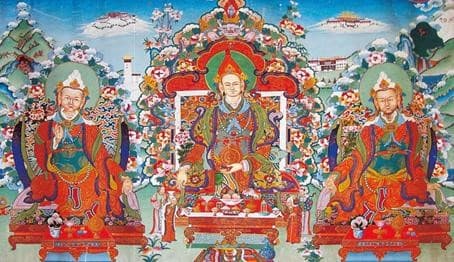
The Three Dharma Kings refer to three renowned monarchs during Tibet's Imperial period: the 33rd king Songtsen Gampo, the 38th king Trisong Detsen, and the 41st king Tri Ralpachen. In traditional Tibetan art, Songtsen Gampo is typically depicted in the centre, flanked by the other two kings, all portrayed in equal size. This arrangement became a standard format in Tibetan thangkas, sculptures, and murals. These figures are not deities but historical figures whose achievements are well-documented in Tibetan historical records. Here is an overview of their accomplishments based on the "Tibetan-Chinese Great Dictionary."
☸️ Songtsen Gampo Originally named Tri Songtsen (Tibetan: ཁྲི་སྲོང་བཙན།, Wylie: Khri Srong bTsan, Tibetan Pinyin: Chisongzän), he was honoured with the title "Songtsen Gampo" (meaning "righteous and kind, unfathomably wise" or "the righteous, stern and wise ruler"). As the 33rd ruler of the Tibetan Empire, he established his palace on Mount Potalaka in Lhasa, created the Tibetan writing system, and initiated the translation of Buddhist texts. He established six major legal codes and formed matrimonial alliances first with a Nepalese princess and later (in 641 CE) with the Tang Princess Wencheng. He oversaw the construction of the Jokhang and Ramoche temples, sent noble youth to study at the Imperial College in Chang'an, and introduced medicine, mathematics, and technology from China. He made significant contributions to Tibet's economic and cultural development and fostered relationships with neighbouring peoples. The Tang court bestowed upon him the titles of Imperial Son-in-Law General and Prince of Western Sea. After his early death, his grandson Mangsong Mangtsen succeeded him.
Songtsen Gampo established a series of laws and ethical guidelines for the Tibetan Empire based on the "Ten Virtuous Precepts," including "Fifteen Legal Codes," "Seven Major Laws," and "Sixteen Rules of Human Conduct," totalling thirty-seven articles. Only a small portion were mandatory legal regulations; most fell under social ethics.
Based on the "Ten Virtuous Precepts"
Songtsen Gampo's minister Thonmi Sambhota initially translated several Buddhist texts, including the "Sutra of Ten Virtuous Actions", which expounds on the Buddhist "Ten Precepts" (or "Ten Virtuous Laws"). The "Ten Precepts" comprise "Three of Body" (no killing, stealing, or sexual misconduct); "Four of Speech" (no divisive speech, harsh words, lying, or idle chatter); and "Three of Mind" (no greed, hatred, or delusion). Body, speech, and mind represent action, language, and thought. The "Ten Precepts" evolved from the "Five Precepts" but with different emphases. The "Five Precepts" focus on avoiding evil, while the "Ten Precepts" emphasise doing good. The "Ten Virtuous Actions" derived from the "Ten Precepts" include: overcoming desire through meditation on impurity, defeating anger through compassion, eliminating ignorance through understanding causality, replacing falsehood with truthful speech, substituting divisive speech with harmonious words, using loving speech instead of harsh words, speaking directly rather than frivolously, preserving life instead of killing, practising generosity instead of stealing, and maintaining purity instead of sexual misconduct. The "Five Precepts and Ten Virtuous Actions" form the foundation of Buddhist ethics. From a Buddhist perspective, observing these ensures rebirth in favourable realms and avoids the three lower realms; even if liberation isn't achieved in this life, practice can continue in future lives.
According to the "Scholars' Feast", the "Sixteen Rules of Human Conduct" were established by adding six additional rules to the "Ten Non-virtuous Actions": honouring father and mother, respecting monastics, revering elders, showing gratitude, and not harming others. These later evolved into more practical guidelines for common people:
- Take refuge in and revere the Three Jewels
- Honour and repay parents' kindness
- Return kindness with virtue
- Respect and heed superiors
- Emulate the wise
- Study Buddhist teachings and writing diligently
- Trust in karma and avoid evil
- Benefit others rather than harbour ill intentions
- Act justly without deceit
- Practice moderation in food and drink
- Know shame
- Repay debts on time
- Use honest weights and measures
- Avoid interfering in matters not entrusted to you
- Be decisive and steady in adversity
- Treat oaths and promises as sacred as life itself
Beyond these sixteen rules, other legal codes included provisions for honouring heroes, wise men, and good people while condemning cowards, evil-doers, and lawbreakers. These formed both social ethics and state law. The "Six Major Political Requirements", one of the "Thirty-six Fundamental Institutions" of the later Tibetan Empire, explicitly mandated "following the ten virtuous actions and abandoning non-virtuous ones". These thirty-seven laws and behavioural guidelines became the standard of conduct for everyone in Tibet, from rulers and ministers to common people.